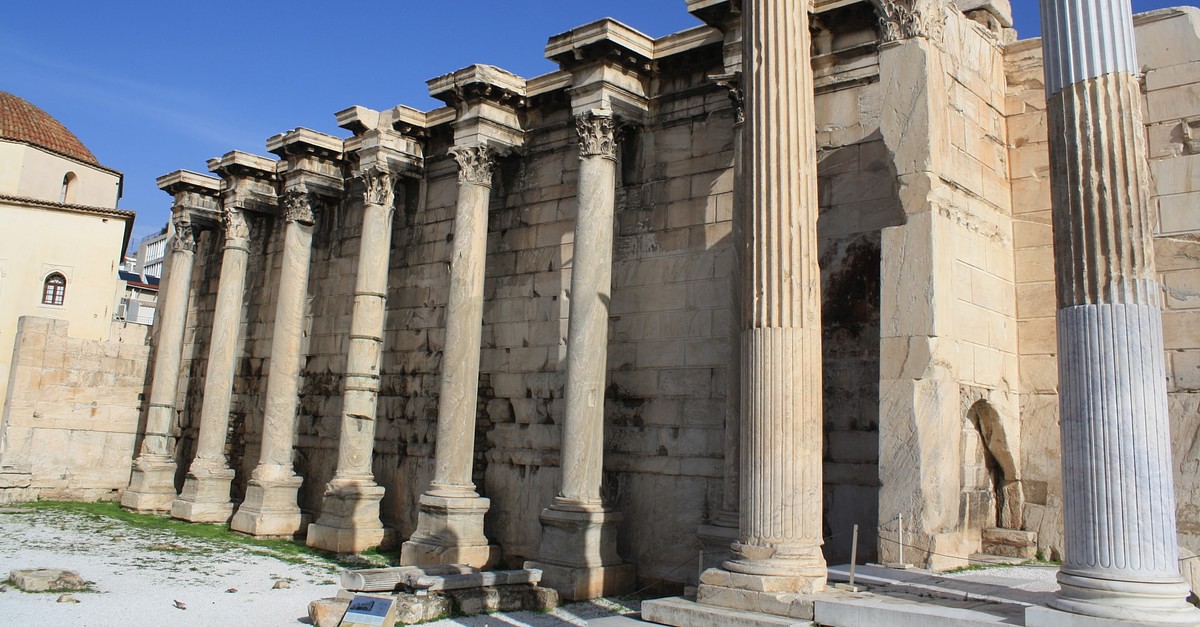
Beautiful view of Hadrian’s Library

Hadrian’s Library

Athens, Greece
i

Beautiful view of Hadrian’s Library

Stone columns rise quietly above the city’s chatter, dust swirling around ancient marble. A pocket of calm emerges just beyond busy Monastiraki Square, where history feels almost close enough to touch. Here, in the sheltered ruins of Hadrian’s Library, the past lingers, waiting for those willing to wander its silent pathways.

Visiting Info

Currency
Entrance fee
6 EUR
Hours
Opening hours
Monday: 8:00 AM – 8:00 PM
Tuesday: 8:00 AM – 8:00 PM
Wednesday: 8:00 AM – 8:00 PM
Thursday: 8:00 AM – 8:00 PM
Friday: 8:00 AM – 8:00 PM
Saturday: 8:00 AM – 8:00 PM
Sunday: 8:00 AM – 8:00 PM

Contact Information

Location
Address
Κ, Areos 3, Τ, Athina 105 55, Greece

Planning your visit

Most travelers discover Hadrian’s Library during a day of exploration around central Athens—but a bit of planning can turn a quick look into a memorable stop. Crowds often drift in from surrounding markets, especially during midday. For those aiming for a quieter visit, early mornings and late afternoons promise a gentler experience. Located steps from the Monastiraki metro station, the site connects conveniently to both the Acropolis and the ancient Agora, making it easy to include on a self-guided walking circuit. While tickets rarely sell out, lines sometimes grow during holiday weekends.

  • Best time to visit: Spring or autumn mornings for cooler air and softer light; winter for truly peaceful moments
  • How to get there: The Monastiraki metro stop sits barely 100 meters from the entrance; plentiful buses and taxis serve the area
  • Accessibility: Reasonably flat walkways suit most visitors, but some uneven stones require care; accessible for families and seniors with rest benches available
  • Average visit duration: 30 to 60 minutes, depending on pace and curiosity

Must see stuff

Walking through Hadrian’s Library, sunlight dances across the vast courtyard framed by broken columns—remnants of a 2nd-century Roman empire project intended for scholars, public readings, and community gatherings. Although the library’s books vanished long ago, the layers of stone provide a striking glimpse of Athens as it reinvented itself through centuries of Byzantine, Ottoman, and Greek history.

  • Main courtyard: Once paved in shining marble, still scattered with column fragments and hints of garden beds
  • Eastern wall and library chambers: The best-preserved side of the complex, with visible niches carved for once-prized scrolls and codices
  • Byzantine-era churches: Tiny and surprising—one tucked inside the library’s northern edge, preserving traces of wall paintings
  • Photo spots: The iconic view of ancient columns with the Acropolis rising behind, plus narrow passageways echoing with history
  • Local life blend: Street musicians and market sounds drifting over low, weathered walls, offering a modern contrast to timeless ruins
  • Fun fact: Emperor Hadrian named the complex after himself, hoping to rival the libraries of Alexandria—though the library also housed lecture halls, gardens, and music rooms

Tips for your visit

Whether stopping for a midday pause or as part of a longer history walk, a few simple habits can turn a visit from ordinary to inspiring. The strong Greek sun pushes visitors toward shaded corners; don’t overlook these nooks for a rest and a deeper look at ancient stonework. Information signs help, but a quick read about Hadrian’s rule before arriving lets those hidden details come alive. While the site remains mostly safe, watch foot placement on slick marble and keep an eye on little kids weaving among the stones.

  • Best times to avoid crowds: Early morning before 10 a.m. or towards closing
  • What to bring: Hat, water bottle, sturdy shoes, and a smartphone or camera for photos; a compact guidebook for context
  • Etiquette: Respect roped-off areas—even tempting loose stones tell important stories
  • Comfort tip: Stop for a coffee at a nearby café before or after for some local flavor; shaded cafes line the adjacent streets